Palazzo Contarini del Bovolo
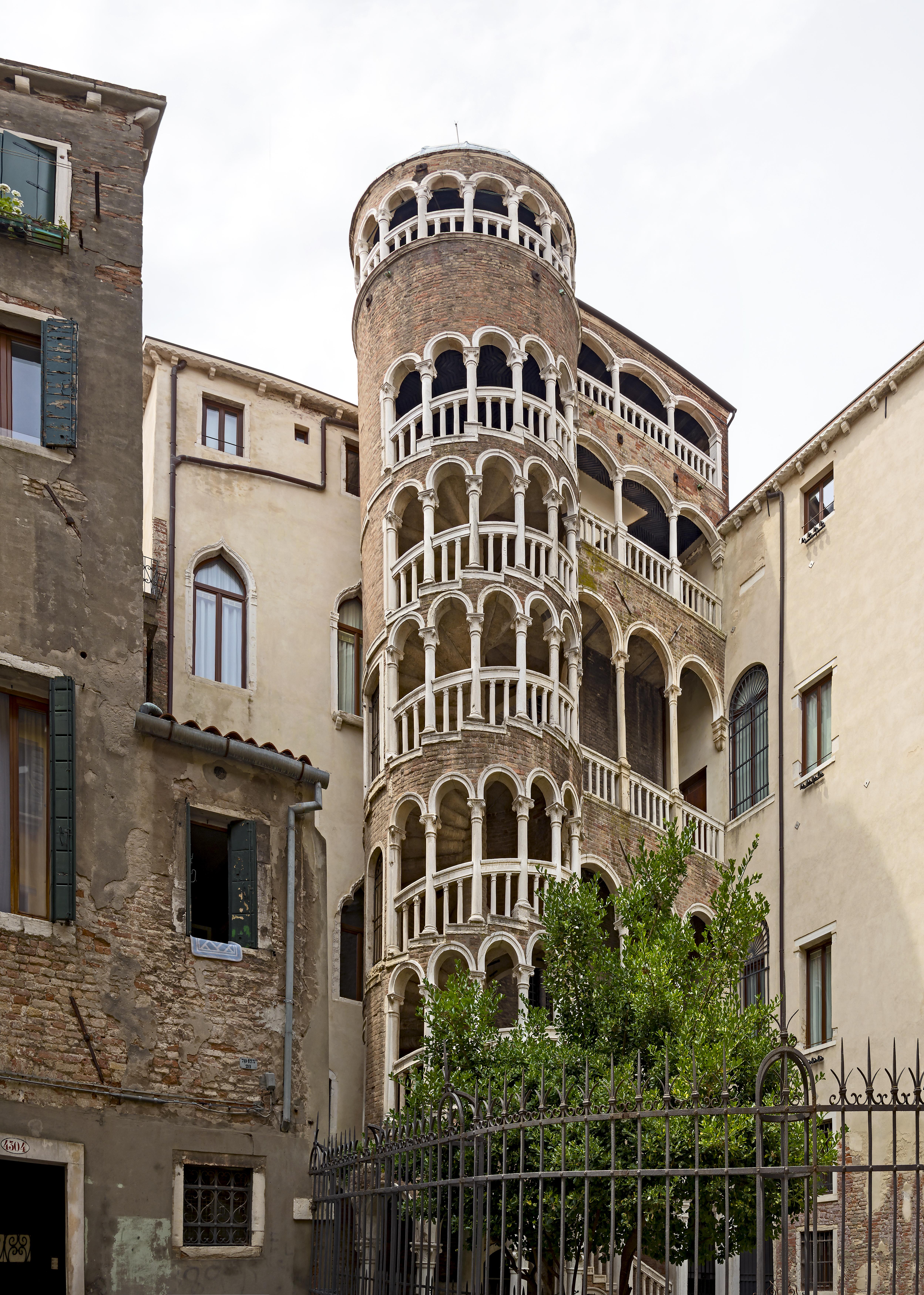
The Palazzo Contarini del Bovolo hides down a narrow side street in central Venice. It sits about halfway between the Rialto, once the city's commercial heart, and Piazza San Marco, its political centre. What pulls you off the main route is the staircase winding up the outer wall like a snail shell. Few Venetian palaces put their stairs on display like this.
The site began as a fourteenth-century fontego, a warehouse with lodgings, before a fifteenth-century rebuild made it the Contarini family's city residence. The staircase itself took shape in 1499, usually credited to Giovanni Candi, though some historians give Giorgio Spavento a share. Eighty monolithic steps wind counterclockwise up a cylindrical tower about twenty-six metres high, their arches alternating red brick with white Istrian stone. The tower spans six floors, though the palace holds a ground floor and four storeys. Gothic construction, Renaissance capitals and Byzantine-Venetian shapes meet in the same walls. Down below, the ground-floor arcade opens onto a small garden courtyard where well heads still stand. Faded fragments of the original floral frescoes survive inside. No point of the climb shows the Grand Canal. From the top terrace, though, you look over the rooftops towards St Mark's Basilica and its campanile.
Later centuries brought humbler tenants: in the nineteenth century Arnaux Marseille, known as il Maltese, turned the place into a lodging house. The story goes that this nickname inspired Hugo Pratt's comic hero Corto Maltese. One lodger, the astronomer Ernst Wilhelm Tempel, found a comet and the Merope Nebula of the Pleiades from the top floor. After 1849 the building passed to the city's public welfare services. Orson Welles chose the palazzo as Brabantio's house in his 1952 film of Othello, and the staircase is clearly visible in it.
- City
- Venice
- Content updated
Take this page with you
The myTuur app is free, and once you are standing at a spot its story starts by itself.


Spots like this one are the stops myTuur strings into tours through Venice. In the app, each story begins where you stand: walk up to a spot and it starts, read it on screen or listen as you go, then follow the route to the next one.
What is myTuur?
myTuur is a free city-guide app. Its tours are built from spots, and each spot carries a story that starts when you get there, to read or to listen to as you like.