Pantheon di Santa Maria in Stelle
The Pantheon di Santa Maria in Stelle lies beneath a church in Verona, built entirely underground in the third century. A Roman noble, Publio Pomponio Corneliano, raised it with his wife and children, as the inscription over the entrance records. A statue in a niche inside probably shows the patron himself. He held public office in Verona and Vicenza. Its first purpose is still argued over: a family tomb, an aqueduct, or a nymphaeum for the nymphs of springs. A natural spring inside lends the water theory weight.
From the fourth century the rooms served as a Christian chapel, a use that lasted into the twelfth. When the church above grew in the fifteenth century, workers sealed the old entrance and built the staircase you still climb. Two large rooms with apses open off a cross-shaped atrium, their semi-domes pierced by round openings. Mosaic floors and wall paintings from that conversion count among the major early Christian cycles of northern Italy. The left room's mosaic survives almost whole, with dark red patterns outlined in black and plant motifs on white. Frescoes there show Old and New Testament scenes between two red bands, an arrangement some read as preparation for baptism. A Hand of God appeared in the eighth or ninth century, a Virgin and Child in the starry vault a century later. The right room also holds a first-century Roman altar to an adopted daughter of the Pomponia family.
Rediscovered in the eighteenth century, the rooms have fought damp ever since, and restoration between 2016 and 2019 secured the paintings. A lighting system installed in 2020 lets the guide light each scene one at a time from an app. The spring still runs along its Roman course. It sheds its impurities in a rock-cut semicircular basin, then slips through a vaulted corridor a hundred metres long, past four wells.
- City
- Verona
- Content updated
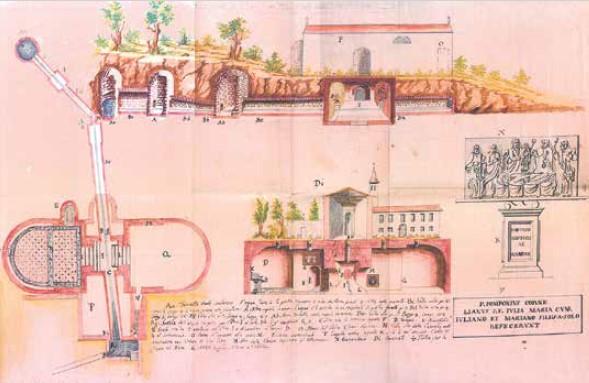
Image: Gaetano CristofaliPublic domain
Take this page with you
The myTuur app is free, and once you are standing at a spot its story starts by itself.


Spots like this one are the stops myTuur strings into tours through Verona. In the app, each story begins where you stand: walk up to a spot and it starts, read it on screen or listen as you go, then follow the route to the next one.
What is myTuur?
myTuur is a free city-guide app. Its tours are built from spots, and each spot carries a story that starts when you get there, to read or to listen to as you like.