Forte Porta Nuova
Forte Porta Nuova was an Austrian fortress on the plain outside Verona, built between 1848 and 1850. It stood about 1,100 metres from the Porta Nuova gate, at the head of a long tree-lined avenue. There the roads from Mantua and Legnago met, and guns on its flanks could sweep them both. Major Conrad Petrasch, then director of the Imperial Royal Office of Fortifications in Verona, oversaw the construction. It honoured Count Eduard Clam-Gallas, a lieutenant field marshal and brigade commander under Radetzky in the campaign of 1848 and 1849.
Its plan was an elongated, asymmetrical semi-octagon with a central keep and a rear keep. The central keep was a single-level segment of a cylindrical tower, its earth-covered roof serving as an artillery platform. More guns stood in casemates on the ground floor. The rear keep had a cruciform plan, projecting partly from the rear front as a defensive caponier. Two entrance portals with drawbridges sat symmetrically either side of it. Batteries on the two opposing flanks fired from two levels, one in casemates and one in the open air. A detached Carnot wall, completed in 1859, guarded the bottom of the dry moat with three caponiers for flanking artillery.
The fort joined Forte Palio and the Tombetta tower as the eastern hinge of the fortified line along the Adige. It belonged to Verona's first entrenched field, a system of forts and towers raised between 1848 and 1856. Even after the second entrenched field appeared in 1861, it oversaw a broad sector behind Dossobuono, Azzano and Tomba. In wartime, a garrison of about seventy men manned fourteen guns, drawing water from a well between the two keeps. After the First World War it was completely levelled, and nothing of it stands today.
- City
- Verona
- Content updated
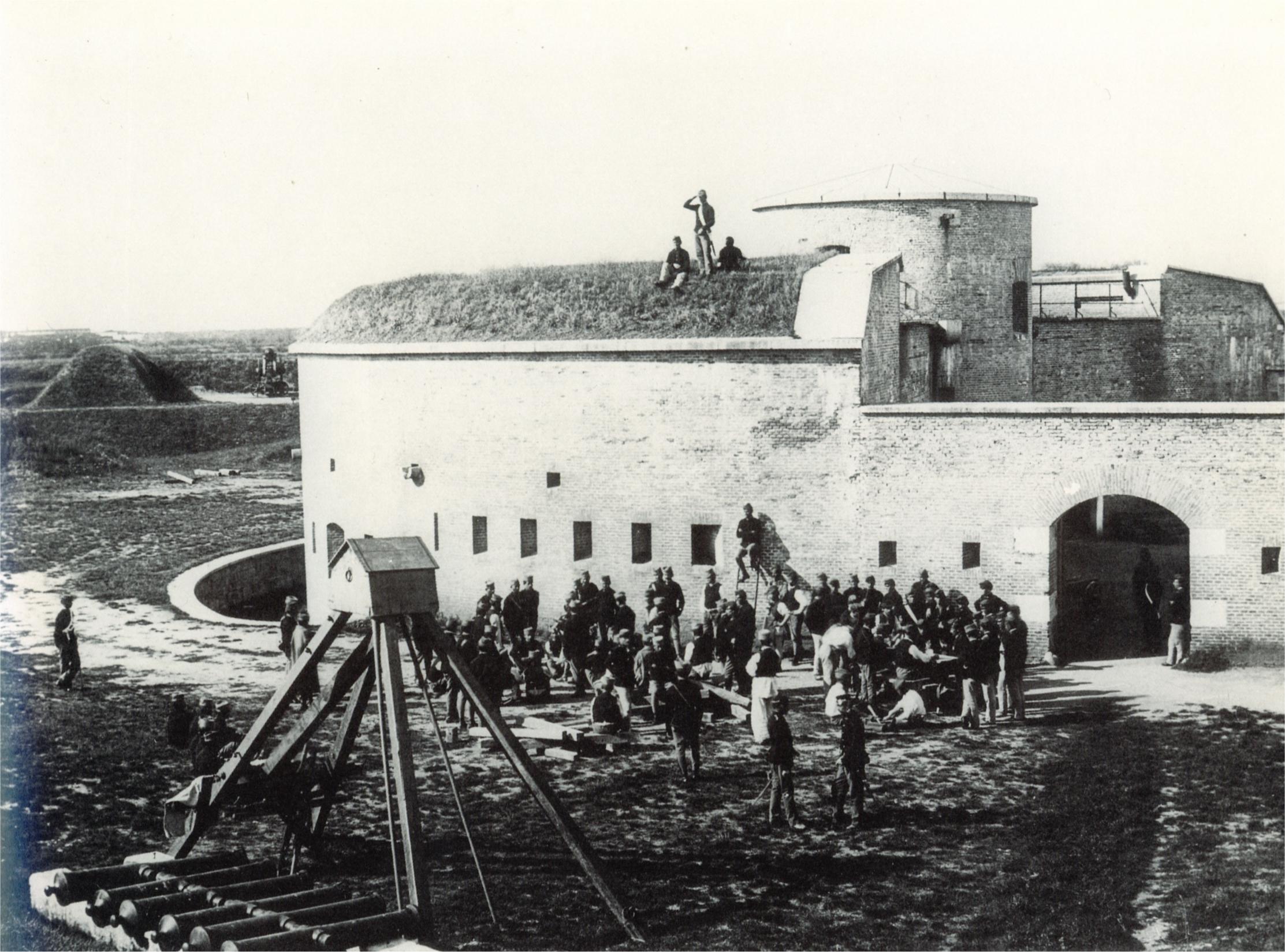
Image: Maurizio LotzePublic domain 
Image: bramfab crop from unknow artsitPublic domain
Take this page with you
The myTuur app is free, and once you are standing at a spot its story starts by itself.


Spots like this one are the stops myTuur strings into tours through Verona. In the app, each story begins where you stand: walk up to a spot and it starts, read it on screen or listen as you go, then follow the route to the next one.
What is myTuur?
myTuur is a free city-guide app. Its tours are built from spots, and each spot carries a story that starts when you get there, to read or to listen to as you like.