Friedrich Klug
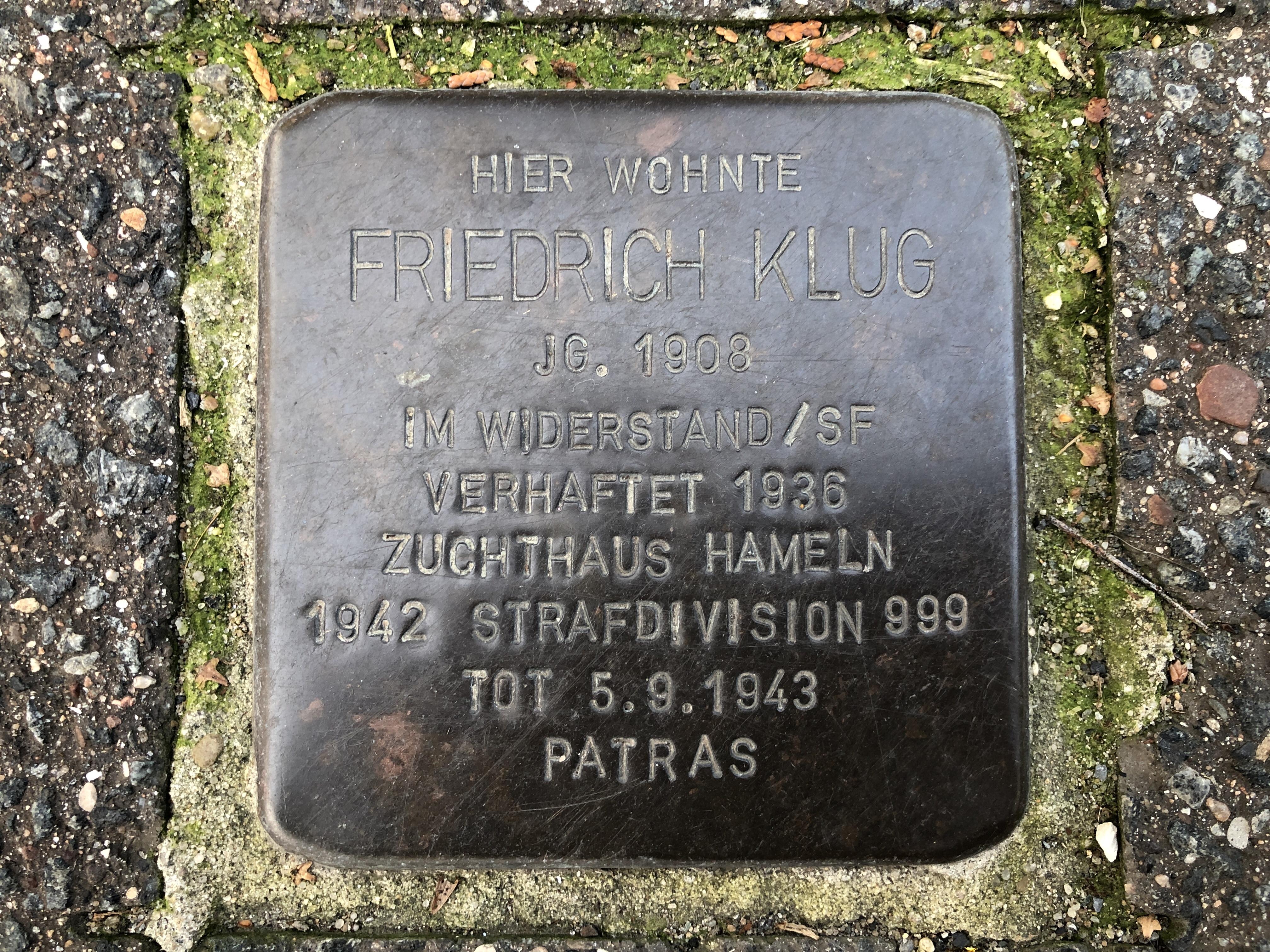
Outside number 25 Sommerfeldstraße in Hanover's Ledeburg district, a small brass-plated stone sits level with the pavement. The inscription beneath your feet names Friedrich Klug, a bookkeeper born in Schulenburg on 19 August 1908. It is one of the Stolpersteine, the memorials Gunter Demnig has set into pavements across Europe for victims of the Nazi regime.
During the Weimar Republic he was an active member of the workers' sports club Turn- und Sportverein Mecklenheide. He became its chairman in 1933, with a focus on youth development. The Nazis dissolved and seized the club during the Gleichschaltung. Klug then joined a resistance organisation, the Socialist Front, distributing leaflets and recruiting new members. Arrest followed on the twenty-second of September 1936, on a charge of preparation for high treason. He spent the years until 1939 in Hameln prison. Deemed unworthy of military service when the war began, he was nevertheless conscripted into a penal company in Greece in 1943. There he contracted dysentery and died the same year.
On the sixth of October 2014 Demnig set the stone into the pavement, with Klug's relatives and friends standing close by. Number 25 is the last home he chose for himself. A few lines of brass hold his whole life: bookkeeper, club chairman, leaflet distributor, prisoner, victim.
- City
- Hanover
- Content updated
Take this page with you
The myTuur app is free, and once you are standing at a spot its story starts by itself.


Spots like this one are the stops myTuur strings into tours through Hanover. In the app, each story begins where you stand: walk up to a spot and it starts, read it on screen or listen as you go, then follow the route to the next one.
What is myTuur?
myTuur is a free city-guide app. Its tours are built from spots, and each spot carries a story that starts when you get there, to read or to listen to as you like.