Römische Ruine
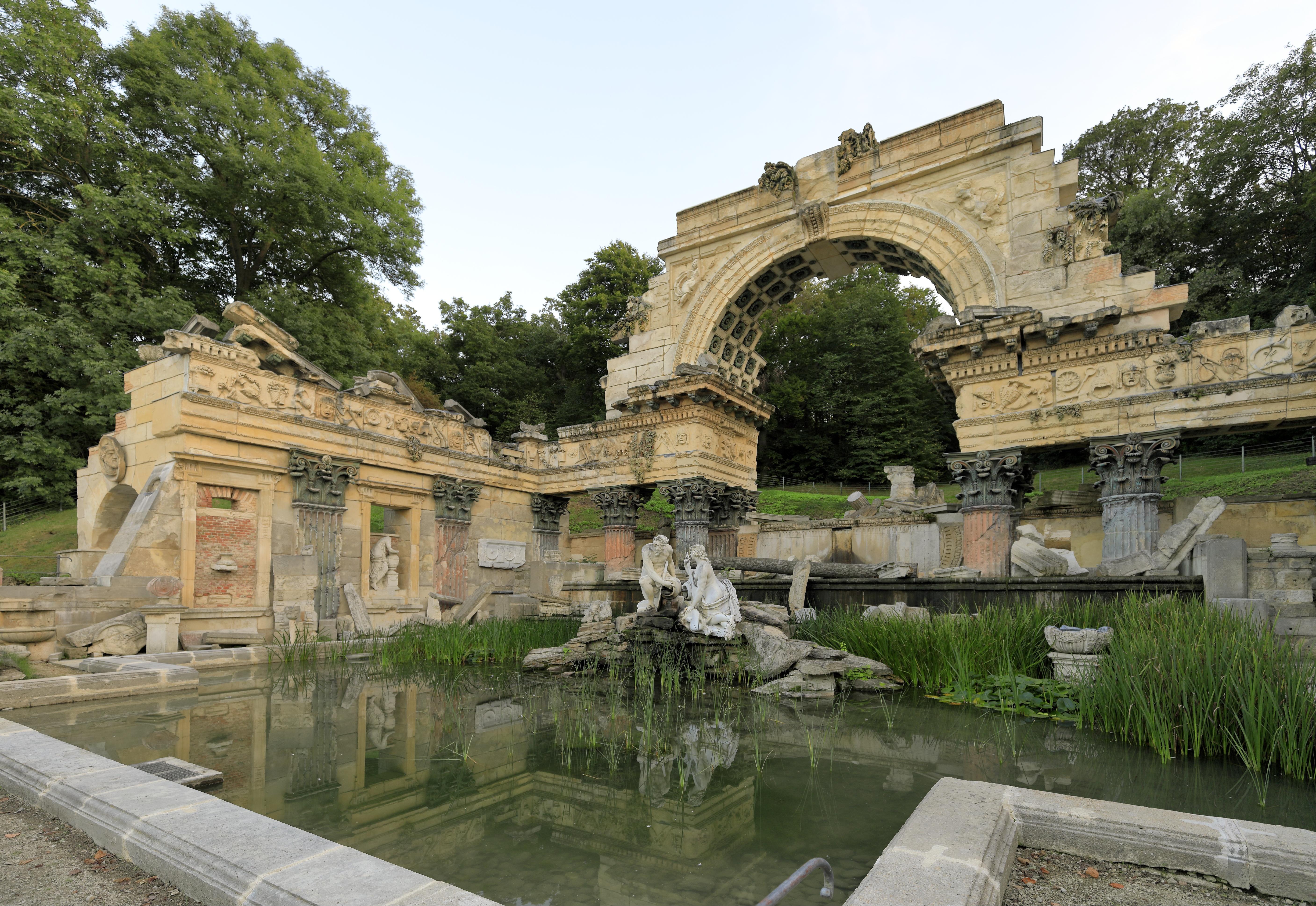
In the gardens of Schönbrunn Palace in Vienna, below the wooded slopes of Schönbrunn Hill, you come upon the Römische Ruine. Johann Ferdinand Hetzendorf von Hohenberg designed the ensemble, which went up in 1778. Nothing in it is a genuine relic of antiquity: the decay itself was designed. When the structure was new, people called it the Ruin of Carthage.
The fashion for artificial ruins began in England before the middle of the eighteenth century. Vienna took it up a few decades later. Hohenberg turned to the ancient Roman temple of Vespasian and Titus, recorded around 1756 in an engraving by Giovanni Battista Piranesi. The result is a rectangular pool framed by a massive semi-circular arch. Its fragmented architrave and frieze carry reliefs of sacrificial implements after Roman models. Side walls set at right angles mimic a building slowly crumbling into the ground, their reliefs joined by classicistic figures and busts. The court architect supervised every element here, columns and reliefs included, unlike the Gloriette elsewhere in the park. Beyer, Henrici and Franz Zächerle cut the stone decoration. Stones from the Neugebäude Palace served only the decorative compositions around the building. Wilhelm Beyer populated the pool with river gods of the Danube and the Enns, carved from Sterzinger marble.
The Habsburgs saw themselves as legitimate successors of the Roman Empire, and the ruin carried that claim into the garden. A defeated Carthage at the foot of their own hill put Rome's triumph on show. Ferdinand Georg Waldmüller painted the ensemble in 1832. Behind the central arch, a wooded aisle climbs the slope, once terraced as a cascade. The path ends at a statue of Hercules fighting Cerberus, the three-headed dog guarding the entrance to Hades. Personified vices stand around the group, and the defeated Hydra lies beneath Hercules' feet.
- City
- Vienna
- Content updated
Take this page with you
The myTuur app is free, and once you are standing at a spot its story starts by itself.


Spots like this one are the stops myTuur strings into tours through Vienna. In the app, each story begins where you stand: walk up to a spot and it starts, read it on screen or listen as you go, then follow the route to the next one.
What is myTuur?
myTuur is a free city-guide app. Its tours are built from spots, and each spot carries a story that starts when you get there, to read or to listen to as you like.