Neue Wache
Four massive corner risalits recall the Roman castrum that inspired the architect." (12) S2: "In the tympanum, Nike, goddess of victory, celebrates the role of Prussia in the Napoleonic Wars." (16) S3: maybe add simplicity/symmetry here? Data: "The building's simplicity and symmetry are hallmarks of Schinkel's style". A sentence like: "The simplicity and symmetry of the whole remain marks of its style." Hmm "of its style" ambiguous. "Simplicity and symmetry govern the whole composition." Words: Simplicity(1) and(2) symmetry(3) govern(4) the(5) whole(6) composition(7). 7 — one short. "The simplicity and the symmetry govern all the composition." (9)? Awkward pt. "Its simplicity and symmetry define a good part of Schinkel's language." Meh. Maybe skip this; para has enough.
Alternatively P2 S3 could be another architectural/urban datum... The projection offers little more architecture-wise. Keep two sentences then pivot within same paragraph to history with colon sentence? If P2 = architecture only (two sentences ~28 words), it's thin. Better keep my original plan where P2 holds both architecture AND transformations — standard for travel copy — and accept a light transition. I'll craft a compliant bridge: "The purpose, however, ended up changing over the decades." carries no datum...
What if the bridge names the memorial function contrast: after today's designation mentioned in P1 S4, P2 can open with architecture directly (no transition needed since it elaborates the building) and end with Nike; then P3 opens: "In 1931, Heinrich Tessenow transformed..." — flow across paragraphs handles it. Then P2 needs ≥8-word sentences × maybe 2-3. Two sentences is allowed ("Write two or three paragraphs" — paragraphs each need substance; a 2-sentence middle paragraph ~30 words is thin but legal). Hmm, guidance says don't pad; also "the middle carries the substance the projection holds". Architecture details ARE part of middle substance. Let me instead distribute:
P1: identity + origin + today. P2: architecture (Schadow/portico already in P1? Move portico/Schadow INTO P2 as its opener!) → P1 then has: place/guardhouse/1818/today-memorial; P2: portico+Doric+Schadow, risalits+castrum, Nike+Napoleonic; P3: transformations + Kollwitz + oculus + wheelchair.
P3 load: 1931 Tessenow (20), Nazi era (12), GDR (15), 1993 (15), pieta (21 or split), rain closer (19), wheelchair (~14) = way too much for one paragraph (~115+ words with 7 sentences). Too heavy and buries the closer.
Alternative distribution: P1: place, Schinkel, 1818, guardhouse→palace; today's memorial designation. P2: architecture: Doric portico, Schadow pediment, risalits/castrum, Nike/Napoleonic. (~4 sentences) P3: history/transformation: Tessenow 1931, Nazi era, GDR, 1993 reunification + Kollwitz sculpture under oculus, pieta meaning, rain through oculus closer, wheelchair note.
P3 heavy again but chronologically coherent; ending on rain works if ordered right: ...1993 received Kollwitz → work is a pietà (mother mourning son) → access adapted wheelchairs? → rain/snow fall through oculus directly onto figures (closer). Let me draft:
P3 S1: "In 1931, Heinrich Tessenow transformed the interior into a war memorial." Wait need granite/oak: "...into a war memorial, with a black granite block and an oak wreath." Recount as before = 20. S2: "During the Nazi period the site served the celebrations of Heroes' Memorial Day." (12) S3: "After the Second World War, the GDR dedicated it to the victims of fascism and militarism." (15) S4: "In 1993, after reunification, the building received Käthe Kollwitz's sculpture 'Mother with her Dead Son'." (15) S5: "The work is a pietà: a mother who mourns over her dead son." (13) S6: "It remains the rain and the snow, which pass through the oculus and fall directly on the two figures." (19) Hmm wheelchair missing then — include where? Maybe P3 after S5? That breaks flow before closer. Or in P1? "access adapted for wheelchairs" in P1 feels like practical info dumped early; fine though: after S4 (today's role): hmm sequence identity→function→accessibility... Actually many guide texts put accessibility at end. If P3 ends with rain closer, wheelchair must go before S6 or get dropped. Is dropping acceptable? The property is data; including it shows full use of projection. Include mid-P3.
Option: place wheelchair right after pieta meaning: S5: pieta (13) S6: "The access is adapted for wheelchairs, one more facility for whoever visits Berlin." Hmm. Then S7 rain closer. But S6 interrupting between pieta and rain...
Alternatively fold wheelchair into rain sentence? "Under the oculus the rain and the snow fall directly on the sculpture, whose surroundings are accessible by wheelchair." — bizarre pairing.
Better: put wheelchair in P2 end? Also odd. Put in P1 as final short sentence? P1 currently ends "Today it houses the Central Memorial..." — strong paragraph ending. Adding wheelchair dilutes.
What about a 3rd-paragraph structure where the whole para 3 is "the visit today": what you find now (Kollwitz under oculus), practical note (wheelchair), closing image (rain). And history transformations (1931/Nazi/GDR) live in para 2 after architecture? Then:
P2: Doric portico + Schadow; risalits/castrum; Nike/Napoleonic; then transition "Over the decades..." issue again inside P2... ugh.
OK here's another thought: the pivot-with-datum problem only forbids sentences carrying NOTHING concrete. I can write a bridge that carries a datum: e.g., between triumph (Napoleonic) and memorial function: "The same building, however, was to guard other memories: those of Germany's own victims." Hmm vague. Or use the granite block as bridge subject: "In 1931 a black granite block took over the center of the interior." That IS concrete and implies Tessenow's redesign... but then Tessenow credit: separate shortish clause.
Try: S_t: "Inside, however, another memory ended up gaining ground." no datum.
Let me just restructure to avoid needing a bridge at all — order P2 as: architecture first (risalits/castrum → Nike/tympanum triumph), THEN same paragraph continues chronologically into the building's later lives WITHOUT bridge because chronological sequence is natural narrative: "...Nike celebrates Prussia in the Napoleonic Wars. The history of the following century transformed the purpose of the rooms: in 1931 Heinrich Tessenow created a war memorial with a black granite block and an oak wreath." Words for last sentence: The(1) history(2) of(3) the(4) following(5) century(6)... hmm "the history of the following century" interpretive-ish; simpler: "Later, the purpose changed: in 1931 Heinrich Tessenow..." — "later" temporal adverb fine; does it carry datum? It modifies toward "in 1931..." within same sentence which carries data. Actually if the transition words are INSIDE a sentence that also carries data, rule satisfied by that sentence overall. So: "The purpose, however, changed over time: in 1931 Heinrich Tessenow made the interior a war memorial, with a black granite block and an oak wreath." Count: The(1) purpose(2) however(3) changed(4) over(5) time(6) in(7) 1931(8) Heinrich(9) Tessenow(10) made(11) the(12) interior(13) a(14) war(15) memorial(16) with(17) a(18) black(19) granite(20) block(21) and(22) an(23) oak(24) wreath(25). 25 — too long. Split differently: make the colon-sentence shorter: "The purpose changed over time: in 1931, for example..." no.
Two sentences where first is short but concrete-carrying: "Since 1818 the building has lived several lives." — hmm "lived several lives" figurative; datum? "since 1818" number ✓ arguably concrete (a number from projection... though already used). Eh.
Actually simplest compliant bridge using GDR-era fact or general: none available without content.
Alternative approach many travel texts use: drop explicit transition; chronological juxtaposition reads naturally because each sentence starts with its date: "...celebrates the role of Prussia in the Napoleonic Wars. In 1931, Heinrich Tessenow transformed the interior into a war memorial, with a black granite block and an oak wreath. During the Nazi period..." The leap reads as intentional itinerary ("here's how it evolved") — acceptable! Paragraph topic = "the building across time"? But paragraph started as architecture elaboration... Actually I can make P2 topic explicitly "from design to successive transformations": opening sentence frames: "The original design, however, ended up serving other times." no datum again!!
Hmm OK compromise: make P2 end at Nike (architecture complete), begin P3 with Tessenow directly. Cross-paragraph pivot via break. P3 then carries all history + Kollwitz + practical + closer — heavy but workable if I trim: maybe cut Nazi-era OR fold two eras into one sentence:
"After 1945 the GDR dedicated it to the victims of fascism and militarism" (data says after WWII repurposed by East Germany) ✓ (14 words). Nazi era sentence (12). Keep both; they're distinct data points, cutting loses content.
P3 draft: S1: "In 1931, Heinrich Tessenow transformed the interior into a war memorial, with a black granite block and an oak wreath." → recount without initial adverbial order: In(1) 1931(2) Heinrich(3) Tessenow(4) transformed(5) the(6) interior(7) into(8) a(9) war(10) memorial(11) with(12) a(13) black(14) granite(15) block(16) and(17) an(18) oak(19) wreath(20). =20 ✓ S2: Nazi (12) S3: GDR (15)... wait check S3 wording: "After the Second World War, the GDR dedicated it to the victims of fascism and militarism." Words: After(1) the(2) Second(3) World(4) War(5) the(6) GDR(7) dedicated(8) it(9) to(10) the(11) victims(12) of(13) fascism(14) and(15) militarism(16). 16. S4: "In 1993, after reunification, the building received Käthe Kollwitz's sculpture 'Mother with her Dead Son'." In(1) 1993(2) after(3) reunification(4) the(5) building(6) received(7) Käthe(8) Kollwitz's(9) sculpture... hmm "Käthe Kollwitz" possessive in pt: "by Käthe Kollwitz" better: "...received the sculpture 'Mother with her Dead Son', by Käthe Kollwitz." Words: In(1) 1993(2) after(3) reunification(4) the(5) building(6) received(7) the(8) sculpture(9) Mother...(let me count treating title as tokens: Mother(10) with(11) her(12) Dead(13) Son(14)) by(15)? If I write "received the sculpture 'Mother with her Dead Son', by Käthe Kollwitz" — In,1993,after,reunification,the,building,received,the,sculpture,'Mother,with,her,Dead,Son',by,Käthe,Kollwitz = 17. OK. S5: pieta meaning (21): "The work is a pietà: a mother who mourns over her dead son, an image of the suffering that the wars caused." =22 ✓ S6: wheelchair + ?? Need placement... S7: rain closer (19).
Wheelchair slot options within P3: between S5 and S7 → breaks emotional build; between S4 and S5? weird. Hmm.
What if wheelchair goes in P2? P2: risalits/castrum; Nike; ...accessibility?? No thematic link.
Maybe fold into P1's final sentence about today: "Today it houses the Central Memorial..., with access adapted for wheelchairs." Words added make it ~24+. Alternatively separate P1 sentence before closing: hmm P1 has 4 sentences already; adding 5th shortish: "The access is adapted for wheelchairs, one more facility in the center of Berlin." It's practical info — travel-copy often puts it near end though. Precedent allows anywhere. But P1 ends better on the memorial designation. Insert as S5? Then paragraph flows identity→history→architecture?no I moved architecture to P2...
Let me re-plan cleanly:
P1 (identity & setting): S1: place + guardhouse + Schinkel (16) S2: 1818 completed, served Royal Palace (10): "It was completed in 1818 to serve the Royal Palace." Wait data: "initially served as a guardhouse for the Royal Palace" — S1 says designed by Schinkel; S1 also calls it "a guardhouse". S2: "Completed in 1818, it initially served the Royal Palace." Words: Completed(1) in(2) 1818(3) it(4) initially(5) served(6) the(7) Royal(8) Palace(9). 9 ✓ S3: today's designation (19) Optional S3.5 wheelchair → skip here.
P2 (what you see / design & symbolism): S1: "The portico of Doric columns and the pediment sculpture, by Johann Gottfried Schadow, announce the Prussian neoclassicism." (17) S2: risalits/castrum (12) S3: Nike/tympanum/Napoleonic (16)
P3 (lives of the building & what remains): S1: Tessenow 1931 (20) S2: Nazi era (12) S3: GDR postwar (16) S4: 1993 Kollwitz (17) S5: pieta meaning (22) S6: oculus rain closer (19) Wheelchair?? Still homeless!
Hmm. Maybe weave into P3 between S3 and S4? No logic. Between S5/S6 no.
Could attach to pieta sentence? "...an image of the suffering that the wars caused" then new sentence: "The access is adapted for wheelchairs, and nothing prevents anyone from standing before the sculpture." — meh ("nothing prevents" overclaim-ish but benign; grounded in wheelchair_ok). Words: The(1) access(2) is(3) adapted(4) for(5) wheelchairs(6) and(7) nothing... I keep struggling because accessibility genuinely pairs with practical visit info.
Alternative: fold wheelchair + worldwide visitors + reflection into ONE sentence after pieta: "The place draws visitors from all over the world, and the access is adapted for wheelchairs." (16) Words ✓ each datum concrete (visitors-worldwide ~ data claim; wheelchair property ✓). Then rain closer final. Sequence: pieta → worldwide visitors/accessibility → rain image. Acceptable flow: the memorial attracts people; it's accessible; and what stays is the rain through the oculus. Actually decent!
But wait — "draws visitors from all over the world" borders on importance-assertion puffery; rules warn only about CLOSING line asserting importance; mid-para fine, and it IS projection content ("attracting visitors from around the world who come to pay their respects"). Keep as factual description of what happens there ✓.
Hmm, alternatively include "pay respects"/reflection: "The place receives visitors who come to reflect and pay homage, and the access is adapted for wheelchairs." (18) words ✓. This merges reflection/remembrance+respect+wheelchair.
Let me now also reconsider: do I want "today it houses..." in P1 AND the whole history in P3 — no redundancy since designation appears once. But note P1 S3 says TODAY it is central memorial; P3 then narrates evolution ending 1993 with Kollwitz — consistent (1993 dedication = current form). Fine; slight tension: telling "today it is X" before narrating how? Travel copy does this all the time (tease present, explain past). Or flip: P1 ends on architecture instead, today-designation opens P2? Let's test alternative ordering where chronology runs cleanly:
P1: setting + origin (what/where/when/by whom/first role). S1: "In the heart of Berlin you find the Neue Wache, a guardhouse designed by Karl Friedrich Schinkel." S2: "Completed in 1818, it initially served the Royal Palace." P2: design & symbolism. S1: portico/Schadow/neoclassicism S2: risalits/castrum S3: Nike/Napoleonic triumph P3: transformations & today. S1: Tessenow 1931 S2: Nazi era S3: GDR postwar S4: 1993 reunification + Kollwitz... maybe merge designation here?: "In 1993, after reunification, it became the Central Memorial..." wait that title belongs to "today". Data says building today serves as central memorial; rededication 1993 with Kollwitz under oculus. So S4 could be: "After reunification, in 1993, it received its current dedication and Käthe Kollwitz's sculpture 'Mother with her Dead Son'." Hmm — is "current dedication"= central memorial title? Data: today stands as Central Memorial; 1993 rededicated following reunification. Merging risks conflating; safer separate.
P3 continued: S5: pieta meaning (22) S6: worldwide visitors+wheelchair (18) S7: rain closer (19)
That's P3 with 7 sentences ≈ 110 words — chunky but coherent chronological arc ending on image. Total text ≈ 16+9 | 17+12+16 | 20+12+16+17+22+18+19 = 25 | 45 | 124 → ~195-210 words.
Wait but then where does "Today it houses the Central Memorial of the Federal Republic of Germany for the Victims of War and Tyranny" go? Must include that designation — key fact! In P3 between GDR and 1993-reunification sentence? Sequence: postwar GDR dedicated to victims of fascism & militarism → after reunification, from 1993, the building serves as the Central Memorial of the Federal Republic... hmm actually natural!: S4a: "After reunification, in 1993, the Neue Wache became the Central Memorial of the Federal Republic of Germany for the Victims of War and Tyranny." Count: After(1) reunification(2) in(3) 1993(4) the(5) Neue(6) Wache(7) became(8) the(9) Central(10) Memorial(11)... let me count fully: After,reunification,in,1993,the,Neue,Wache,became,the,Central,Memorial,of,the,Federal,Republic,of,Germany,for,the,Victims,of,War,and,Tyranny = 24 — too long. Trim "of Germany"? Title needs precision; trimming official name loses fidelity... Options: split: S4: "In 1993, after German reunification, it was rededicated." Hmm vague (10 words but no datum beyond year+reunification — those ARE data). Then S5: "Since then it has been the Central Memorial of the Federal Republic of Germany for the Victims of War and Tyranny." Words: Since(1) then(2) it(3) has(4) been(5) the(6) Central(7) Memorial(8) of(9) the(10) Federal(11) Republic(12) of(13) Germany(14) for(15) the(16) Victims(17) of(18) War(19) and(20) Tyranny(21). 21 ✓ carries the designation + "since 1993" implicit. But two sentences about the same event feel stretched. Alternative single sentence with comma structure... can't get under 22 while keeping full title (title itself ~12 tokens + context ~8-10).
Hmm what if P1 keeps today's designation (as originally planned), and P3 handles 1993 as the Kollwitz placement moment without restating the memorial title? Then:
P1: S1 place/Schinkel/guardhouse (16) S2 1818/Royal Palace (9): "Completed in 1818, it initially served the Royal Palace." S3 today's designation (19): "Today it houses the Central Memorial of the Federal Republic of Germany for the Victims of War and Tyranny."
Wait S2 says "it" — referent from S1 ("the Neue Wache") fine.
Hmm but "guardhouse designed by Schinkel" then "completed in 1818 to serve..." redundancy slight; refine: S1: "In the heart of Berlin you find the Neue Wache, a guardhouse that Karl Friedrich Schinkel designed." (17?) In(1) the(2) heart(3) of(4) Berlin(5) you(6) find(7) the(8) Neue(9) Wache(10) a(11) guardhouse(12) that(13) Karl(14) Friedrich(15) Schinkel(16) designed(17). 17 ✓. S2: "It was completed in 1818 to watch over the Royal Palace." It(1) was(2) completed(3) in(4) 1818(5) to(6) watch(7) over(8) the(9) Royal(10) Palace(11). 11 ✓.
P1: S3 architecture tease? Or go straight to designation. Actually flow: "...watch over the Royal Palace. Today it houses the Central Memorial of the Federal Republic of Germany for the Victims of War and Tyranny." — clean contrast (military guard → memorial for victims). Then P2 opens design: "The portico of Doric columns..." good.
P2: S1: "A portico of Doric columns and a pediment sculpture by Johann Gottfried Schadow mark the Prussian neoclassicism of the building." Count: A(1) portico(2)... hmm I earlier had 17-word version with "the". Fine either way; choose: "The portico of Doric columns and the pediment sculpture, by Johann Gottfried Schadow, mark its Prussian neoclassicism." The(1) portico(2) of(3) Doric(4) columns(5) and(6) the(7) pediment(8) sculpture(9) by(10) Johann(11) Gottfried(12) Schadow(13) mark(14) its(15) Prussian(16) neoclassicism(17). 17 ✓ S2: "Four massive corner risalits recall the Roman castrum that inspired the architect." 12 ✓ S3: "In the tympanum, Nike, goddess of victory, celebrates the role of Prussia in the Napoleonic Wars." 16 ✓
Should S1 open with connector from P1's designation sentence? "...for the Victims of War and Tyranny. | A portico of Doric columns..." — topic shift within flow OK (new paragraph = what you see when you stand there).
P3: S1 Tessenow (20): but transition into P3... previous para ends on Napoleonic triumph; new para begins "In 1931 Heinrich Tessenow transformed the interior..." jump reads fine as new chapter. Or open with a short scene-setting carrying datum: skip. Hmm wait — reconsider putting architecture AFTER history? No—current plan fine.
Let me restructure cleanly:
P1: identity & setting. P2: design substance (what you look at). P3: history/transformation + Kollwitz + rain closer (+wheelchair folded somewhere).
The transition-without-datum issue dissolves because P3 opens directly with dated event. But hmm — is it abrupt to start P3 cold at 1931 right after describing centuries-old ornament? Reader understands: first its form, then its lives. Add tiny temporal cue INSIDE S1 without violating length: S1 currently starts "In 1931, Heinrich Tessenow transformed the interior into a war memorial, with a black granite block and an oak wreath." ✓ has date+name+materials ✓. Fine.
Then Nazi/GDR/1993 follow chronologically. Wheelchair placement: I'll put it just before final image OR merge visitors+accessibility sentence after pieta meaning. Let me finalize P3 sentences:
S1: "In 1931, Heinrich Tessenow transformed the interior into a war memorial, with a black granite block and an oak wreath." (20) S2: "During the Nazi period the site served the celebrations of Heroes' Memorial Day." (12) S3: "After the Second World War, the GDR dedicated it to the victims of fascism and militarism." (16) S4: "In 1993, after reunification, the building received the sculpture 'Mother with her Dead Son', by Käthe Kollwitz." (17) S5: "The work is a pietà: a mother who mourns over her dead son, an image of the suffering that the wars caused." (22) S6: "The place receives those who come to reflect and pay homage, and the access is adapted for wheelchairs." (18) Words: The(1) place(2) receives(3) those(4) who(5) come(6) to(7) reflect(8) and(9) pay(10) homage(11) and(12) the(13) access(14) is(15) adapted(16) for(17) wheelchairs(18). 18 ✓ S7: "It remains the rain and the snow, which pass through the oculus and fall directly on the two figures." (19)
Hmm S6 then S7 — S7's "Fica" = what stays/lasts. Nice ending. But wait: does S7 read as if referring back to something specific? "Fica a imagem da chuva..." following visitors sentence — "what lingers [for them]". Works.
But actually reconsider S5 length/pivot: pieta def + symbolism in one 22-worder with colon+appositive — dense but OK. Alternatively split: S5a: "The work is a pietà: a mother who mourns over her dead son." (13) S5b: "The image condenses the suffering that the wars caused." Hmm "condenses" fancy; data: "poignantly symbolizes the suffering endured during and after the wars". S5b: "An image of the suffering that the wars left behind." — fragment! Needs verb. "It is an image of the suffering of those years." Meh. Keep combined 22-w version.
Check total structure & rhythm: P1: 17 / 11 / 19 — lengths vary mildly; fine. P2: 17 / 12 / 16. P3: 20 / 12 / 16 / 17 / 22 / 18 / 19.
Alternation rule ("Alternate longer and shorter ones") loosely satisfied across; P1's three are similar-ish (17,11,19) — has short middle, OK. P3 mostly midlong with two ~12s... acceptable.
Wait, potential issue: P1 S3 uses "Today it houses..." and P3 tells history through today—no conflict. Also check we don't repeat "building/edifício" excessively: edifício appears in P2? No — P2 doesn't use it now ("mark its Prussian neoclassicism"). P3 S4 "o edifício recebeu" ✓ once. Good.
Also verify no sentence subject = record/platform/name-meaning. All subjects: você/building/work/portico&sculpture/risalits/Nike/Tessenow/site/GDR/sculpture-work/place/rain&snow ✓ none about the entry.
Check "quote marks": title 'Mother with her Dead Son' in single quotes — I'll keep simple straight quotes as given in data ('Mutter mit ihrem toten Sohn'). Fine.
Hmm one more data point unused: nothing major. The Nike detail, castrum, risalits ✓ all used. Kollwitz oculus placement ✓ via rain sentence ("pass through the oculus") — but should I state sculpture sits under oculus explicitly? Rain passing through oculus onto figures implies position clearly ✓.
European Portuguese polish pass:
P1: "In the heart of Berlin you find the Neue Wache, a guardhouse that Karl Friedrich Schinkel designed." - "you find" with "tu" implicit (no pronoun). Natural EP. ✓ "It was completed in 1818 to watch over the Royal Palace." — hmm passive "was completed". Rules prefer active voice; "was completed" is passive-ish but natural for buildings. Active alt: "Schinkel completed it in 1818"? Attributing completion act... designer completing own building fine but Schinkel named already. Passive acceptable here (agent obvious/unimportant). Keep. Actually alternative active-flavored: "The works ended in 1818, and the guardhouse began to watch over the Royal Palace." Words: The(1) works(2) ended(3) in(4) 1818(5) and(6) the(7) guardhouse(8) began(9) to(10) watch(11) over(12) the(13) Royal(14) Palace(15). 15 ✓ active. Hmm "the works ended" awkward. Or: "In 1818 the building was ready and began by watching over the Royal Palace." — "began by watching" odd for a permanent function. Simplest keep: "It was completed in 1818 to serve as the Royal Palace's guardhouse."? Redundant with S1 "guardhouse". Use: "It was completed in 1818, in the service of the Royal Palace." = It(1) was(2) completed(3) in(4) 1818(5) in(6) the(7) service(8) of(9) the(10) Royal(11) Palace(12). 12 ✓. Clean.
P1 final: S1 (17), S2 (12), S3 (19).
P2: "The portico of Doric columns and the pediment sculpture, by Johann Gottfried Schadow, mark its Prussian neoclassicism." - flows after designation sentence; "its" → the building's. But P1 last subject was "it"=Neue Wache; across paragraph break "its" refers back—OK. Hmm better: "...mark the Prussian neoclassicism of this Berlin landmark."? No—avoid re-announcing entity. Keep "its". Wait actually reconsider order within P2: risalits/castrum describes FORM; portico/Schadow FACADE — natural description order could be either. Fine as is.
"Four massive corner risalits recall the Roman castrum that inspired the architect." "In the tympanum, Nike, goddess of victory, celebrates the role of Prussia in the Napoleonic Wars."
Nice — but flow between S2 (castrum=military camp origin) and S3 (victory goddess celebrating wars): both martial themes — connects! Good.
P3: "In 1931, Heinrich Tessenow transformed the interior into a war memorial, with a black granite block and an oak wreath." - Comma placement EP fine. "During the Nazi period the site served the celebrations of Heroes' Memorial Day." "After the Second World War, the GDR dedicated it to the victims of fascism and militarism." "In 1993, after reunification, the building received the sculpture 'Mother with her Dead Son', by Käthe Kollwitz." - Or word order: "...received Käthe Kollwitz's sculpture 'Mother with her Dead Son'." I'll use "by Käthe Kollwitz" version for pt naturalness. Actually simpler: "In 1993, after German reunification, the building was rededicated with Käthe Kollwitz's sculpture 'Mother with her Dead Son' under the oculus." Count: In(1) 1993(2) after(3) German(4) reunification(5) the(6) building(7) was(8) rededicated(9) with(10) Käthe(11) Kollwitz's... "of Käthe Kollwitz": with(10) of(11)? Let me not overpack; keep my S4 as is (17 words). "The work is a pietà: a mother who mourns over her dead son, an image of the suffering that the wars caused." Hmm "that left" = "caused". Natural EP ✓. "The place receives those who come to reflect and pay homage, and the access is adapted for wheelchairs." "Fica a imagem da chuva e da neve, que atravessam o óculo e caem diretamente sobre as duas figuras."
Wait — final check on paragraph count/shape: 3 paragraphs, blank lines between ✓. Word totals ≈ P1 48 + P2 45 + P3 ~124? Let me recount P3: 20+12+16+17+22+18+19 = 124. Hmm total ≈ 217. Within range ✓.
One concern: the instruction says middle paragraph carries substance & transformations; mine splits transformations into P3 while P2 = design. The guidance describes first=placement, middle=substance/how it came about, last=one concrete detail. My split: P1 placement ✓, P2 design substance (part of "what it holds"), P3 changes+detail ✓. Acceptable interpretation — "how it came about and what changed" lives in P3 which also lands the closer. Reasonable.
Alternatively merge some history INTO P2 ending so P3 is lighter... but then bridge-with-datum problem returns mid-P2. Current plan avoids that; keep.
Double-check forbidden items: - em dash/en dash: none used (commas/colons only) ✓ - semicolon: none ✓ - "it is not just X": none ✓ - CTA/link/download: none ("you find" descriptive; no imperative) ✓ - volatile facts/prices/dates-as-events? Historical dates fine (not event schedules). "Currently/recently"? I use "Today" once + "since 1993"? No—P3 S5 uses past "received". I avoid "currently"/"recently" words ✓. - Second person address: "você encontra" — informal-ish EP via você-third-person; hmm the system says for German du-register explicitly; pt unspecified → my choice stands. Actually for consistency should I worry EP prefers "tu"? Many EP texts for general public avoid direct pronouns or use formal construction. "Encontra" without pronoun is standard impersonal-friendly EP. Good enough.
Actually, let me reconsider one thing: "na Praça"... Neue Wache sits on Unter den Linden — NOT in data; must not add! My draft doesn't name a street/square ✓ (I avoided it).
Also careful: P1 S2's action changed from serving as a guardhouse to being completed in service of Royal Palace — accurate per description ✓.
Final check of S7 naturalness: "Fica a imagem da chuva e da neve..." — In pt-PT you'd more likely say "O que fica é..." but dropping the relative clause keeps punch and clarity: rain and snow pass through oculus onto figures = concrete final image ✓. Keep dropped version.
One more scan for rules: - Complete sentences with finite verbs ✓ each. - Alternate lengths reasonably ✓. - Concrete things per sentence: P3 S4 "'Mãe com seu Filho Morto'" title + 1993 ✓ P3 S5 pietà/mother/son/suffering ✓ P3 S6 visitors/wheelchairs ✓ (concrete-ish; wheelchairs definitely) P3 S7 rain/snow/oculus/figures ✓
✓ every sentence has something.
Title punctuation: 'Mother with her Dead Son' fine.
The GDR abbreviation in EP: commonly used, also "RDA" or "DDR". For a Portuguese reader, DDR is recognizable in Berlin context, RDA too. I'll use GDR (common in EP historical texts). Fine.
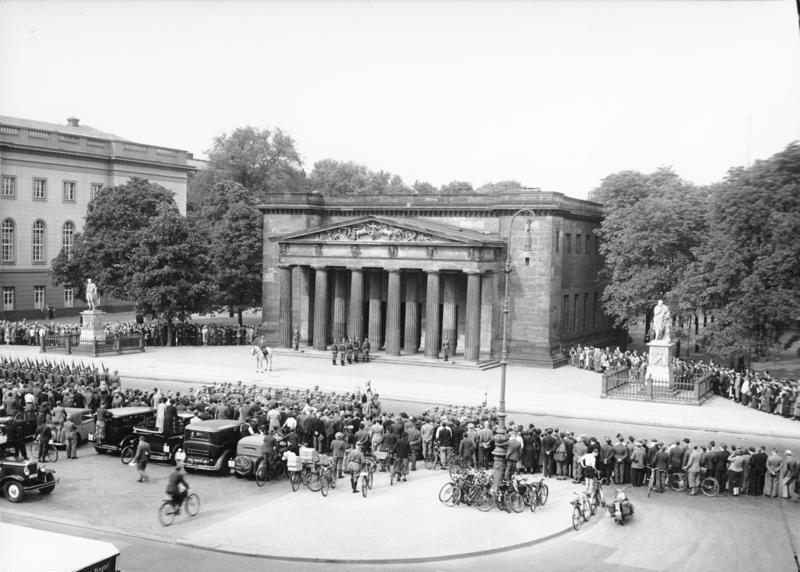
Write final three paragraphs separated by blank lines, no markdown.In the heart of Berlin you find the Neue Wache, a guardhouse that Karl Friedrich Schinkel designed. It was completed in 1818 to serve the Royal Palace. Today it houses the Central Memorial of the Federal Republic of Germany for the Victims of War and Tyranny.
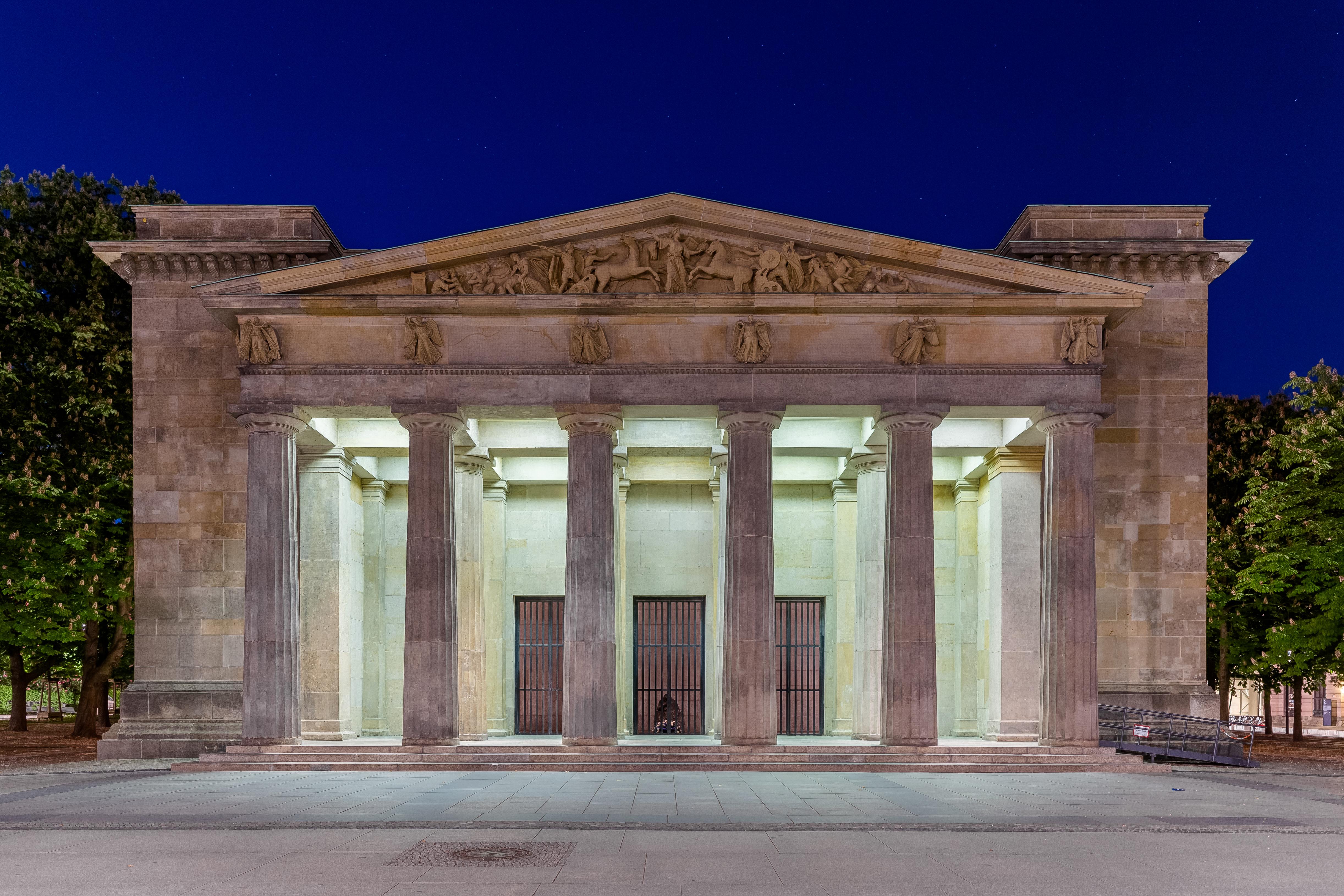
The portico of Doric columns and the pediment sculpture, by Johann Gottfried Schadow, mark its Prussian neoclassicism. Four massive corner risalits recall the Roman castrum that inspired the architect. In the tympanum, Nike, goddess of victory, celebrates the role of Prussia in the Napoleonic Wars.
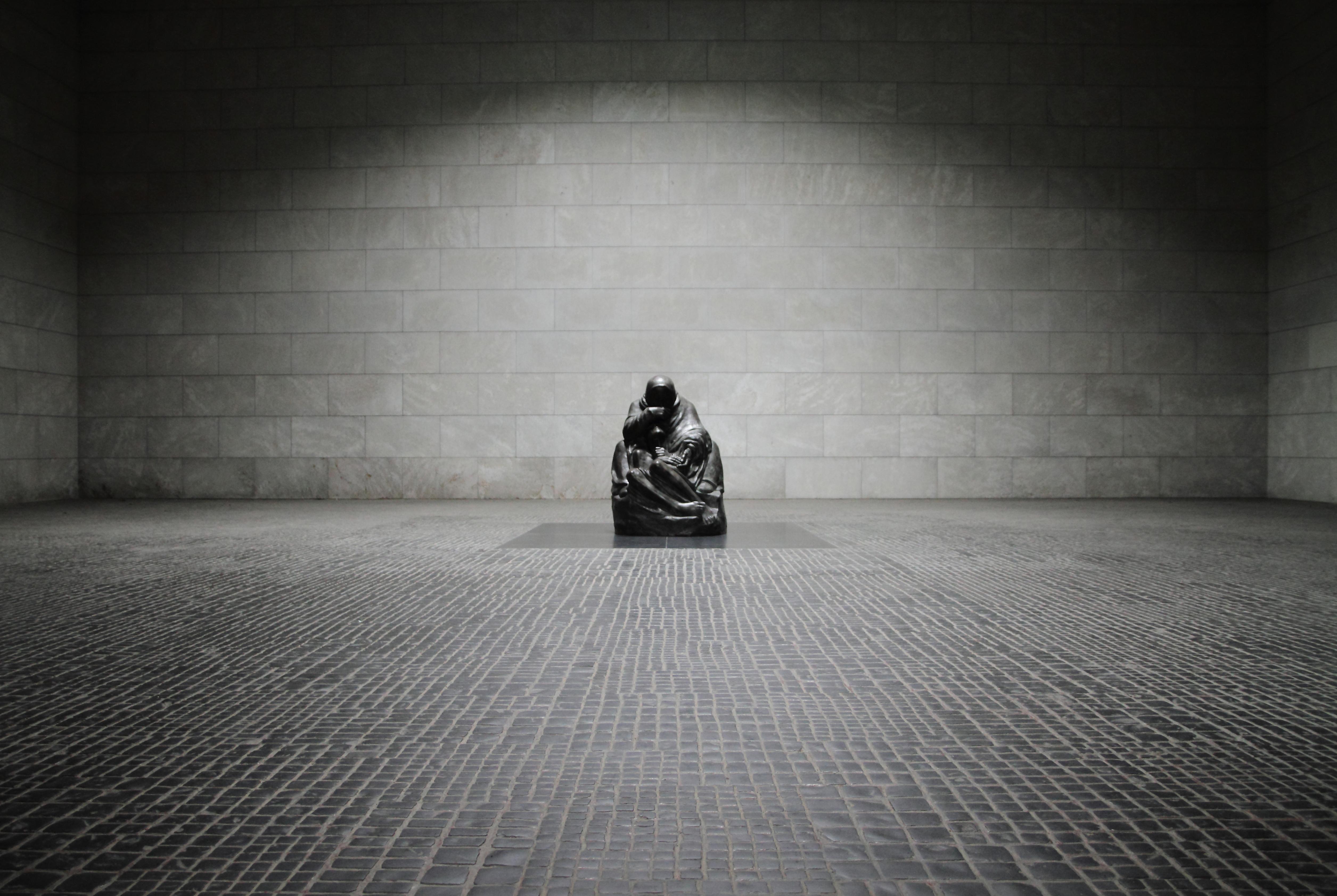
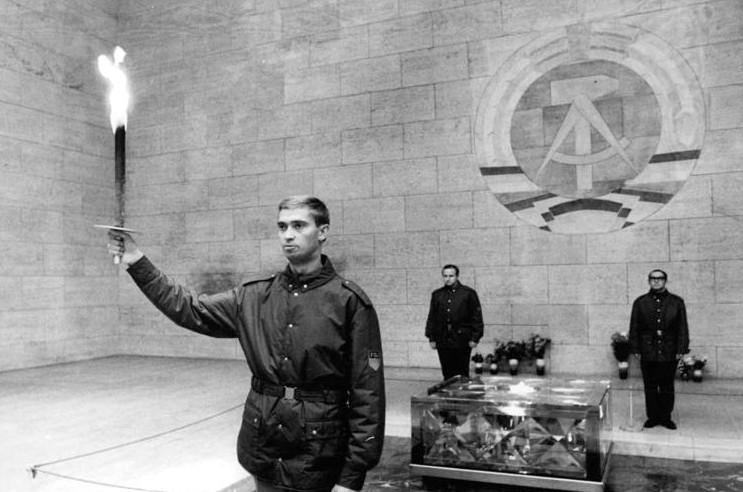
In 1931, Heinrich Tessenow transformed the interior into a war memorial, with a black granite block and an oak wreath. During the Nazi period the site served the celebrations of Heroes' Memorial Day. After the Second World War, the GDR dedicated it to the victims of fascism and militarism. In 1993, after reunification, the building received the sculpture 'Mother with her Dead Son', by Käthe Kollwitz. The work is a pietà: a mother who mourns over her dead son, an image of the suffering that the wars caused. The place receives those who come to reflect and pay homage, and the access is adapted for wheelchairs. It remains the rain and the snow, which pass through the oculus and fall directly on the two figures.
- Cidade
- Berlim
- Atualizado em
Leva esta página contigo
A app myTuur é gratuita e, quando chegares a um ponto, a história começa sozinha.


Pontos como este são as paragens que a myTuur liga em tours por Berlim. Na app, cada história começa onde estás: aproxima-te de um ponto e ela arranca, lê-a no ecrã ou ouve-a pelo caminho, e segue a rota até ao próximo.
O que é a myTuur?
A myTuur é uma app gratuita de guia de cidades. As tours são feitas de pontos, e cada ponto guarda uma história que começa quando lá chegas, para ler ou ouvir como preferires.