Aufstehendes Pferd
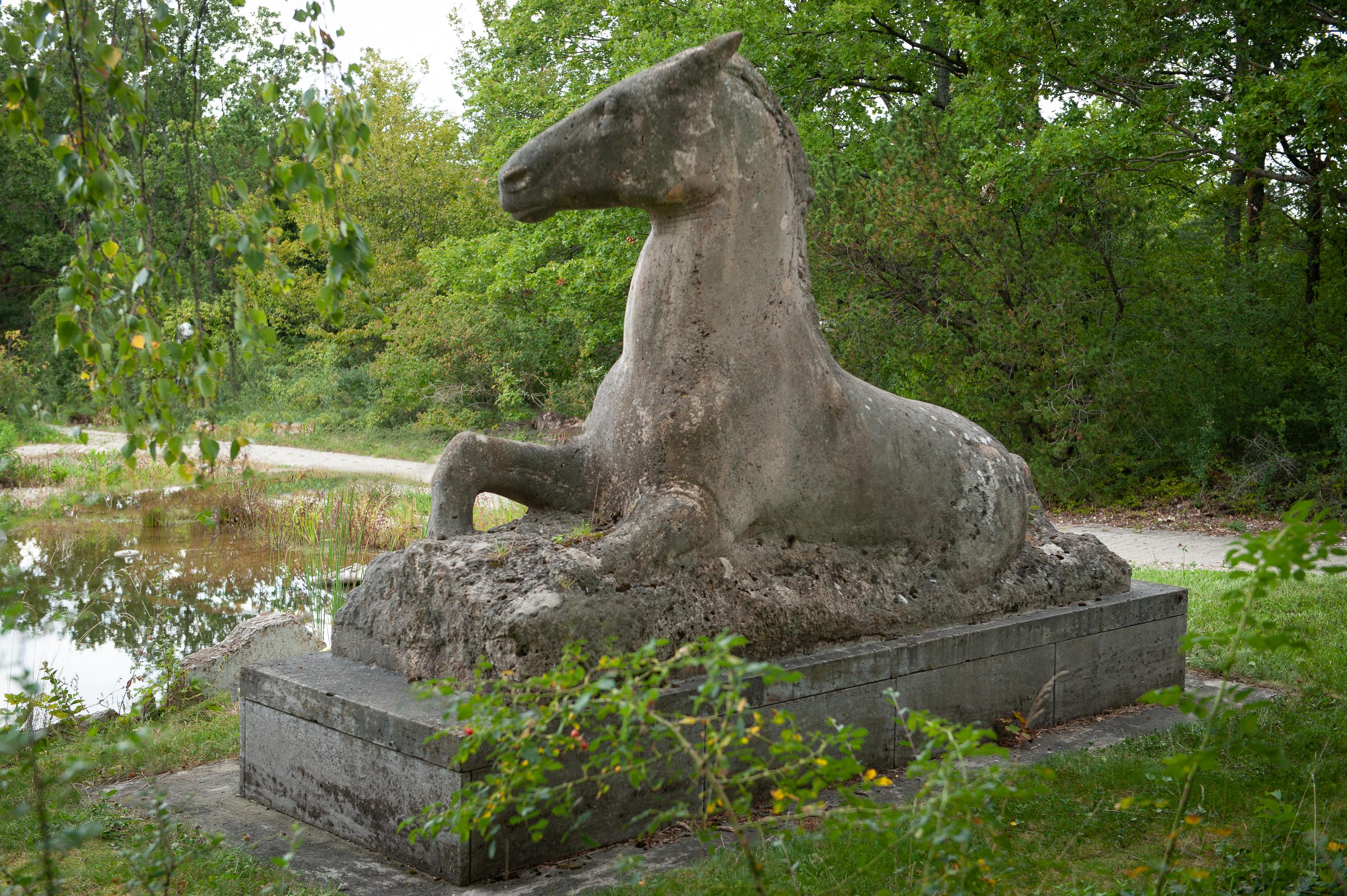
In the garden of the Robert Bosch Hospital in Stuttgart, a stone horse pushes itself up from the ground. The Aufstehendes Pferd is a sculpture by Fritz von Graevenitz, carved from travertine between 1934 and 1935. The pose catches one exact moment: the body still rests while the front legs and the head are already in motion.
Graevenitz made his name with monuments, memorials, fountains, portraits and animal figures, and his career flourished during the National Socialist era. The Große Deutsche Kunstausstellung in Munich's Haus der Deutschen Kunst recognised his work in 1937. In 1938 the horse itself appeared in Warsaw and Krakow, exhibited there under the Polish title Leżący Koń. The piece belongs to the permanent loan collection of the Fritz von Graevenitz Foundation in Solitude near Stuttgart.
Movement is the thread running through Graevenitz's work, and the horse motif recurs in several of his sculptures. This figure remains a noted example of that skill, motion captured inside a static medium. You never see the animal complete the gesture, because the travertine keeps it in that single second between rest and rising.
- City
- Stuttgart
- Content updated
Take this page with you
The myTuur app is free, and once you are standing at a spot its story starts by itself.


Spots like this one are the stops myTuur strings into tours through Stuttgart. In the app, each story begins where you stand: walk up to a spot and it starts, read it on screen or listen as you go, then follow the route to the next one.
What is myTuur?
myTuur is a free city-guide app. Its tours are built from spots, and each spot carries a story that starts when you get there, to read or to listen to as you like.