Merkurbrunnen
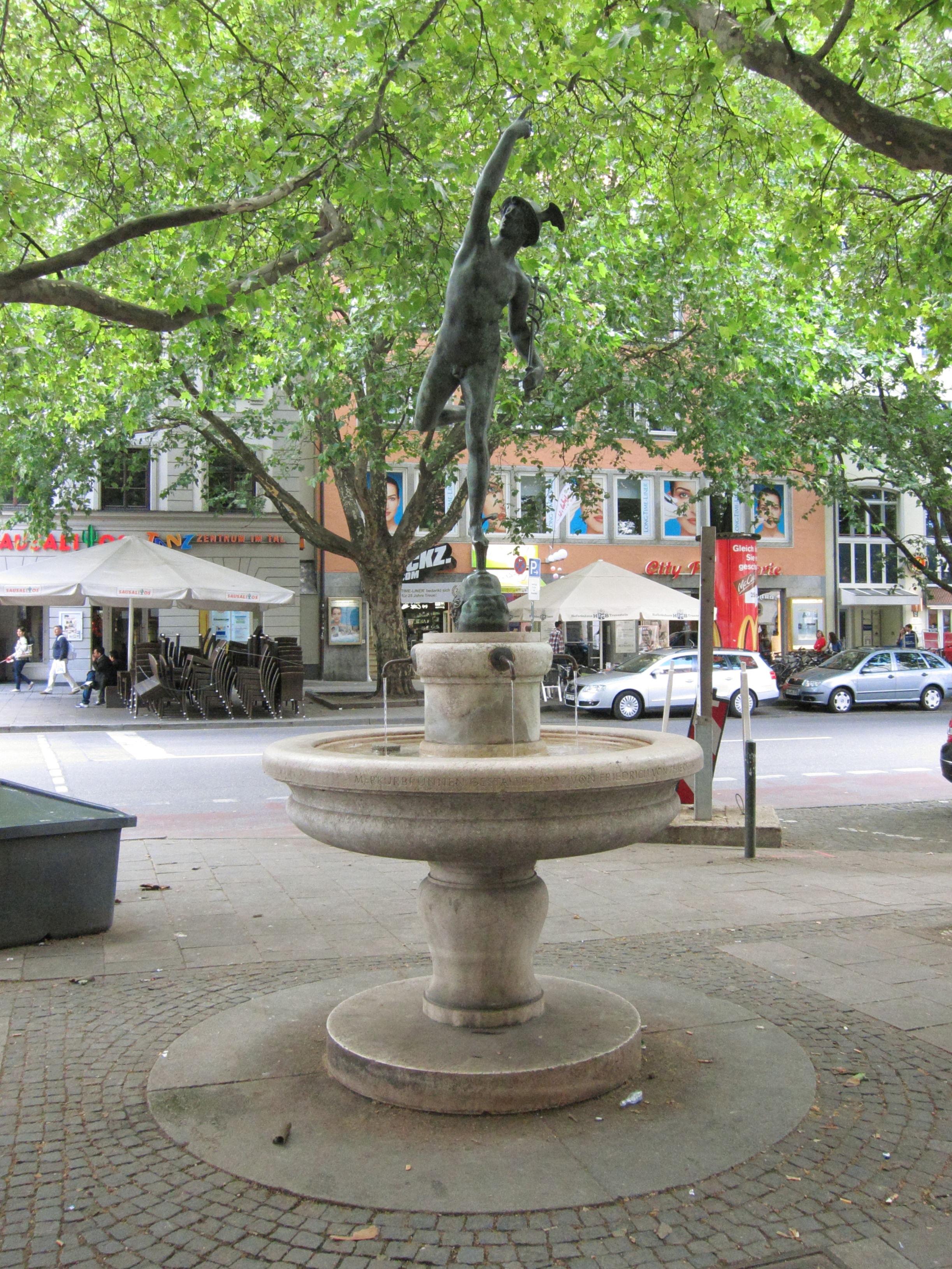
The Merkurbrunnen stands in Munich’s Tal, near the Mohrenapotheke, as a fountain shaped by art, mythology, and upheaval. Architect Friedrich von Thiersch designed it in 1902. It draws inspiration from Giovanni da Bologna’s earlier Mercury sculpture, associated with the European Mannerist tradition. The original Mercury sculpture is housed in Florence, Italy. At the centre, Mercury represents commerce, luck, travel, and his role as messenger among the Roman gods. The Mercury figure balances on his right toe. Zephyr, the wind god, drives the air column beneath him, creating a sculptural image of movement and defying gravity. Mannerism guides the fountain’s unusual sculptural pose. War damage altered the fountain’s history after its original installation in the Eschenanlagen behind the House for Trade and Commerce. The fountain was dismantled and stored in 1966. Restoration followed in 1975, while the stolen Mercury figure was replaced by a donated bronze casting in 1994. That bronze casting completes the fountain’s restored Mercury figure. Its history connects Munich with Florence, Giovanni da Bologna, and the changing life of public sculpture. The Merkurbrunnen brings Roman mythology into a central Munich setting.
- City
- Munich
- Content updated
Take this page with you
The myTuur app is free, and once you are standing at a spot its story starts by itself.


Spots like this one are the stops myTuur strings into tours through Munich. In the app, each story begins where you stand: walk up to a spot and it starts, read it on screen or listen as you go, then follow the route to the next one.
What is myTuur?
myTuur is a free city-guide app. Its tours are built from spots, and each spot carries a story that starts when you get there, to read or to listen to as you like.